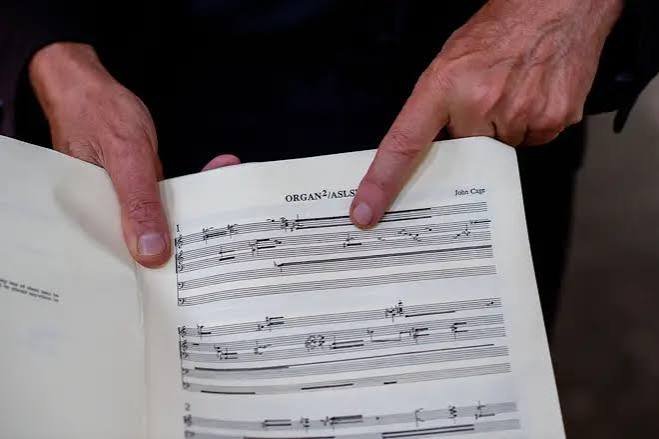
Mark your calendars. Something thrilling is going to happen in St. Burchardi’s church in Halberstadt, Germany on August 5, 2026…
Since my original essay on John Cage’s famous — and famously long — composition was written in July 2013, when I’d been blogging for less than six months, odds are high only a few of you saw it the first time around. Allow me to share it with you again, modified to accommodate recent developments and the exciting August 5th change.
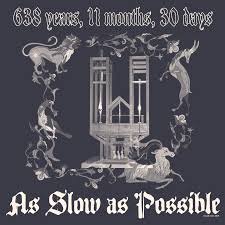
John Cage’s organ composition “As Slow As Possible” is, at the risk of sounding obvious, intended to be played slowly. Its 1987 premier lasted twenty-nine minutes. A subsequent performance lasted seventy-one minutes. Some musicians have made it last for over eight hours. But a few years after Cage’s death in 1992, a group of musicologists, theologians, philosophers and musicians began to meet regularly in order to discuss and ponder aloud just how slow “As Slow As Possible” could be.
The answer: 639 years.
They came up with this number after much slow (what else?), careful consideration. Halberstadt cathedral’s famous Blockwerk organ—granddaddy of the modern organ with its twelve-note claviature—was completed in 1361 (639 years counting back from the year 2000). Therefore the piece should last as long as the modern twelve-key organ has. This also made the town of Halberstadt, in eastern Germany, an obvious location for the performance. The venue is the medieval church of St. Burchardi, which, since being built around 1050, has served as a monastery, a barn, a distillery, an abandoned building and an East German pigsty. It has been cleaned up, though. Quite nicely. And in the middle of the empty church sits an organ. In 2001, it was a decidedly makeshift sort of instrument, ever in the process of evolving. See, it was built specifically for this project, currently fitted with only the pipes required for the current notes being played. Taking 639 years to perform a piece tends to lend itself to such flexibility. Today’s version looks a lot different from the 2001 version. The 2008 version. Et cetera.
And now back to August 5, 2026, which is bringing something startling, thrilling, to St. Burchardi’s church and Cage’s centuries-long performance. Its 17th chord change. A new note added. An A note, to be precise. The harmony, the existing sonority, is about to become denser and richer.

This, after what is now a full generation of music-listening for the townspeople of Halberstadt. It was surely an auspicious moment, on September 5, 2001, as the performance commenced. Perhaps, though, a bit anticlimactic. The piece begins with silence, you see. Several counts’ worth. So from September 5th to February 2003, the only sound was the low whoosh of the electric bellows as they filled with air in preparation for striking that first chord.
Finally, on February 5, 2003, it happened. The first chord. Then, on July 5, 2004, notes were added and the tone changed. January 5, 2006 saw a chord change. (Changes always occur on the fifth day of the month, in honor of Cage and his birth date.)
And here’s where it got exciting. On July 5, 2008, the weights holding down the organ pedals were shifted. Two more organ pipes had been added alongside the four installed and at 3:33pm local time, the sixth chord change in the piece occurred. The crowd of 1000 gathered for the event murmured appreciatively at the increased tonal complexity. Then, thirty seconds later, upon realizing that was it, that was all that was going to happen that day, that month, they commenced a spattering of uncertain applause that grew heartier as officials confirmed the full change had actualized.
How whimsical, how philosophical, to ponder such slowness in comparison to our fast-paced world. Each movement of “As Slow As Possible” (officially titled the less catchy “ORGAN2/ASLSP”) lasts roughly seventy-one years. Think about it. The mind-expanding nature of such an endeavor reminds me of the 2007 British cheddar cheese website (www.cheddarvision.tv) where a web-cam allowed you to watch a fifty-pound cheddar age, real time, 24/7, for twelve months. In fact, that’s what the John Cage Project website needs. Think of all the classical music people out there who could tune in to listen to this performance. To say you’ve heard part of this performance, in real time. And not have to pay the air and train fare for a trip to rural eastern Germany for a ten minute visit, because, face it, you’re probably not going to want to listen to that drone for much longer than that.
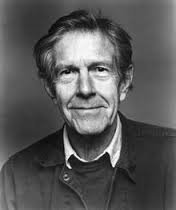
The point of the John Cage ORGAN2/ASLSP Project, its creators argue, is to challenge our precepts of time, of speed. Challenge the inexorable acceleration of the world’s pace. If it, in turn, challenges the patience of classical music and/or John Cage detractors everywhere, well, that’s not a bad thing. In fact, that’s precisely what John Cage would have wanted.
If you go to the project’s website – http://www.aslsp.org – you can hear the chord currently being played (by clicking on “Aktueller Ton” on the right-hand side). It’s a rather horrible sound to sustain, a cross between a dial tone and an approaching train sounding its horn. Those living nearby have complained, which, in truth, doesn’t surprise me. In fact, the concept of never hearing silence in your home in your lifetime is daunting, another issue that merits pondering by philosophers and musicologists. They have ample time to do it, after all. 629 more years, to be precise.
Following the next note change on August 5, 2026, there will be a “sound change” on August 5, 2027, with another on the same date in 2028. One more change on February 5, 2029, and then you will have to wait until 2034 for something new. That’s a long wait.
The Classical Girl hopes to still be here to share all the excitement with you.
The performance is scheduled to end in 2640.