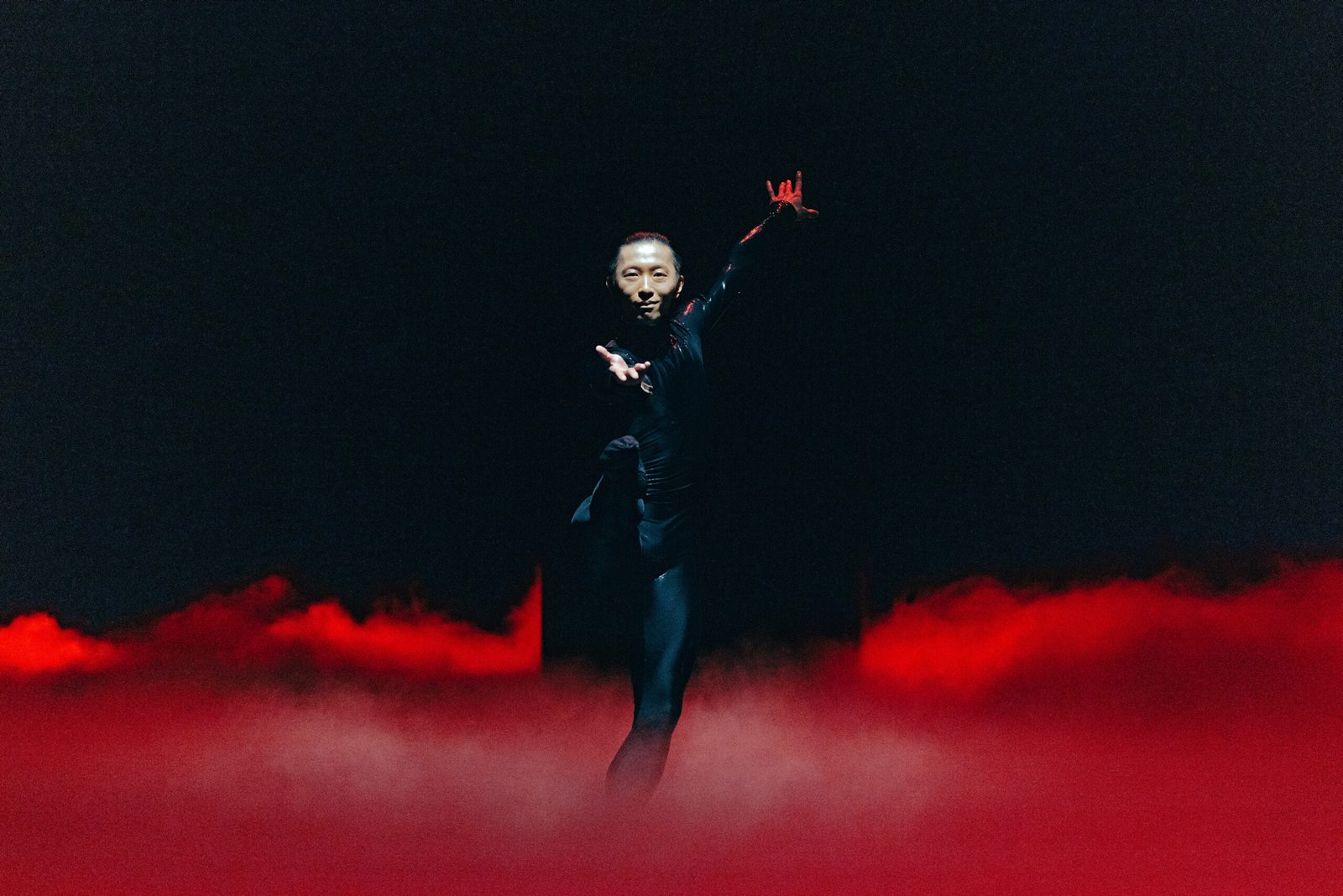
Am I allowed to say that back in 2024, I didn’t love the buzzy world premiere of Aszure Barton’s Mere Mortals? I’m still not sure if I’m brave enough to say “I hated it” because it brought such wide acclaim from critics and audience members alike with only a minority of naysayers. It seemed very clear that people either loved it or hated it.
But now it’s 2026, and much like the mythical Pandora at the core of Mere Mortals, I found myself unable to tamp my curiosity on what a second viewing of this ballet would feel like, particularly when my friend who’d loved the ballet in 2024, expressed keen interest in joining me a second time. So off we went, last Saturday afternoon at San Francisco’s War Memorial Opera House, giving Mere Mortals a second try.
Canadian choreographer Aszure Barton created Mere Mortals as a collaborative effort that includes Barcelona-based Hamill Industries, a creative studio that develops cutting-edge AI-informed visuals, and Floating Points (AKA Sam Shepherd), a U.K.-based composer and producer who creates transportive sonic environments. Intriguingly, Floating Points performed live right alongside the San Francisco Ballet Orchestra, on the Buchla, a synthesizer developed in the Bay Area in 1963, that interprets and loops the orchestra’s instrumentation.
You’re familiar with the Pandora myth, right? In a nutshell, the cunning Prometheus has stolen fire from the gods and, in punishment, they create Pandora, giving her beauty, spirit, and a sealed jar (or box) she’s told never to open. Prometheus warns his brother, Epimetheus, to steer clear of her, but brothers will be brothers, and Epimetheus, dazzled by Pandora, ignores the advice, a decision, coupled with Pandora’s curiosity, with unforeseen consequences. But the myth is only half the ballet’s story. The other half is an exploration of artificial intelligence in our day, which, we can all agree, is its own Pandora’s box, a potentially explosive, risky experiment brought about by our endless curiosity, the pursuit of all knowledge, and a naive disregard for the consequences.
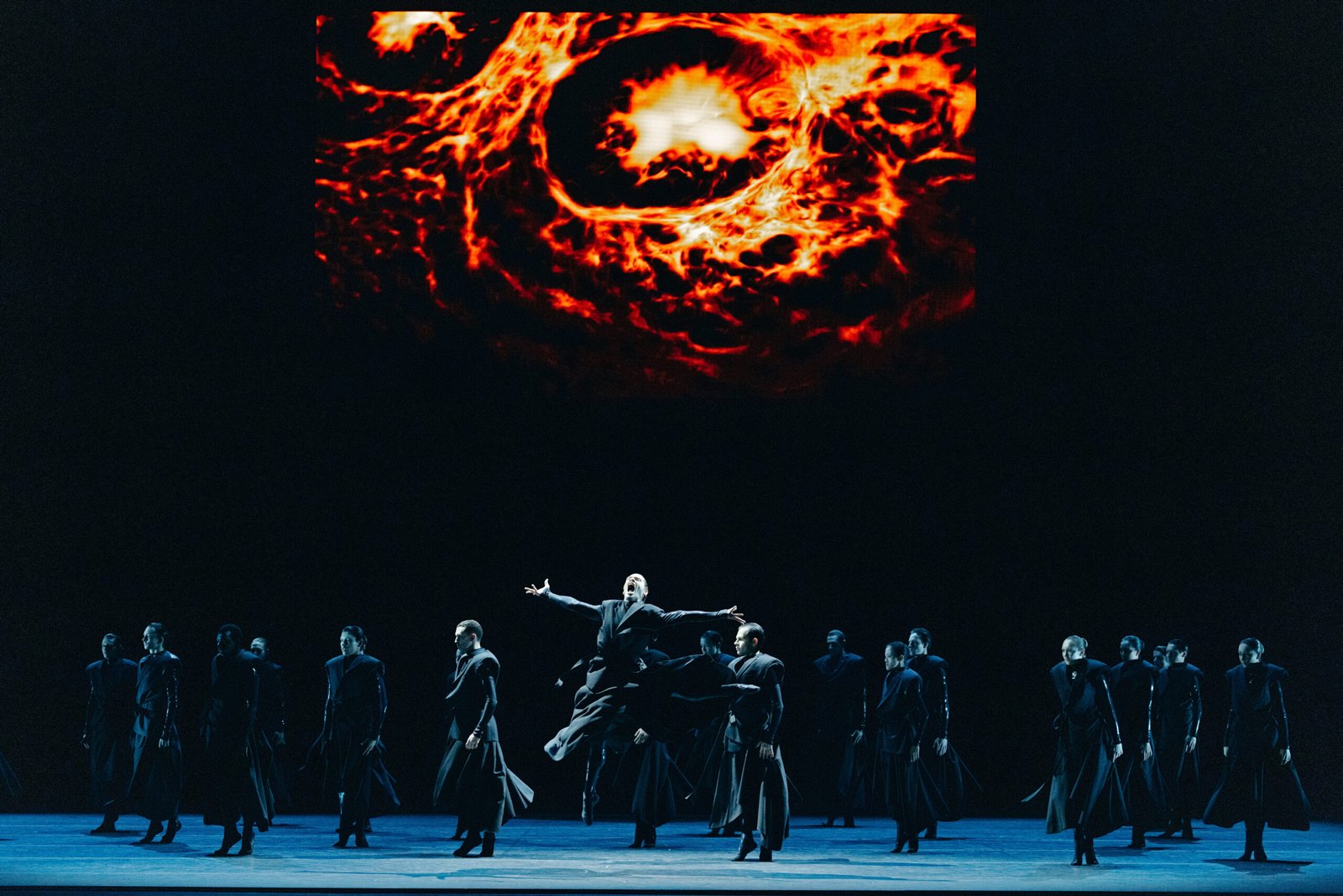
The ballet commences with semi-darkness and upstage LED panels emitting a red glow (Jim French, lighting design), fog shrouding the stage floor. A lone dancer, Hope, (Mingxuan Wang), clad in a sleek, latex black unitard that seemed to have been poured on him (costume design by Michelle Jank) performs an introspective solo—oh, the liquid beauty of his fluttering arms—that both intrigues and lulls until the percussive accompaniment increases and in the blink of an eye, he’s gone, the upstage red panels have pivoted around to shine blinding white stage lights out at the audience, and out marches an ensemble of forty-three dancers, in unisex costumes of long, belted black coats over skirts. They fill the stage fast, in rhythmic formation, bobbing their heads in precise, hypnotic unison. It’s very in-your-face (literally, in the case of the blinding white lights), and boy does it make a powerful impression.
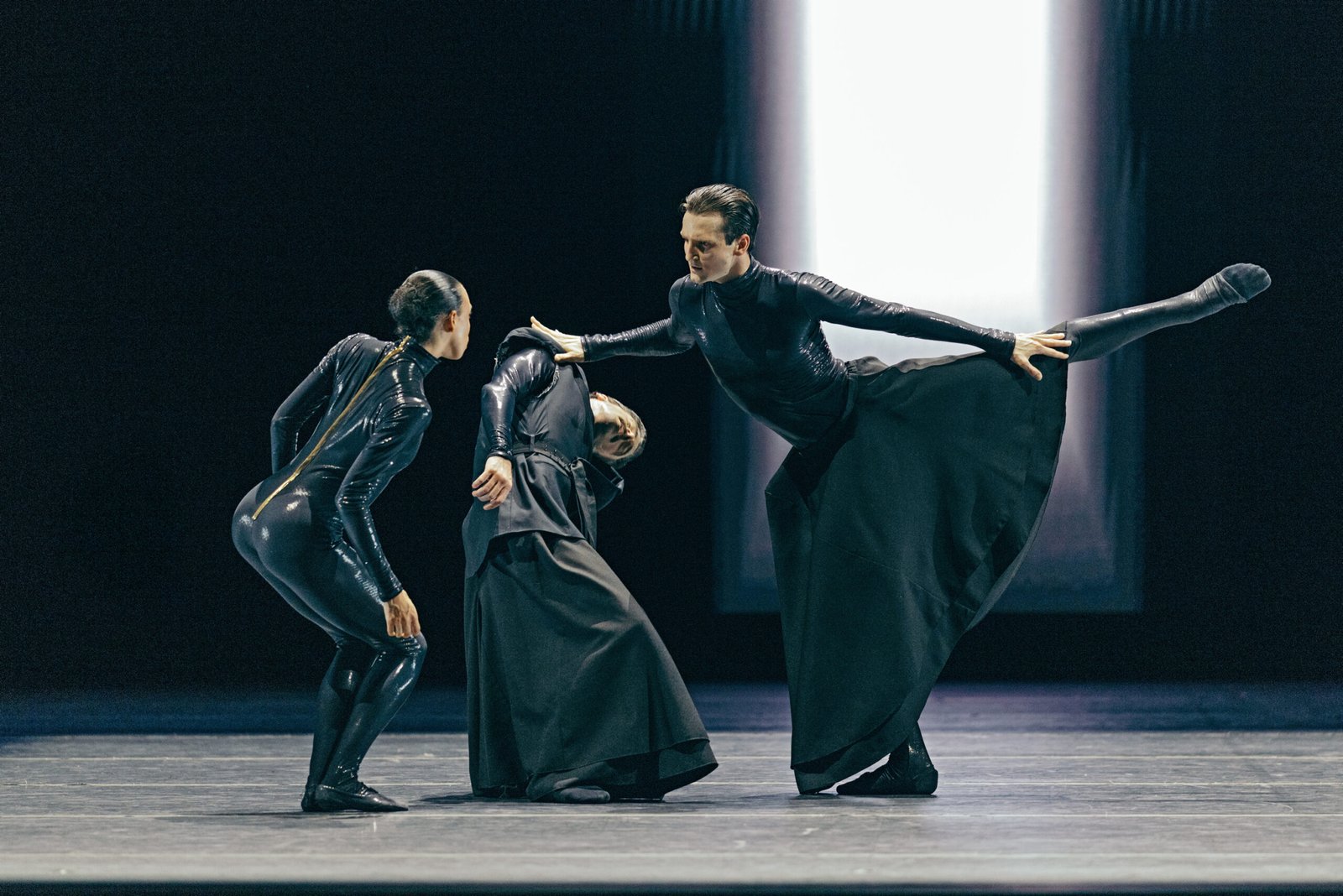
Pandora (Madeline Woo) is the story’s focal point, certainly when it comes to the bulk of actual ballet. Joining the company as a principal in 2025, this is the first time I’ve seen her perform, and she’s a beautiful dancer with fluid grace, glorious extensions and an emotional intelligence the role of Pandora requires. Also noteworthy on Saturday afternoon were Cavan Conley as Prometheus and Justin-Cooper Meeks as Epimetheus who, with Woo, delivered a knockout pas de deux set to some of the night’s most beautiful music, thanks to Annabel Taubl on the harp, a delicate touch atop Floating Points’ generated music. (This beauty was repeated later, when Cordula Merks on solo violin accompanied the music.)
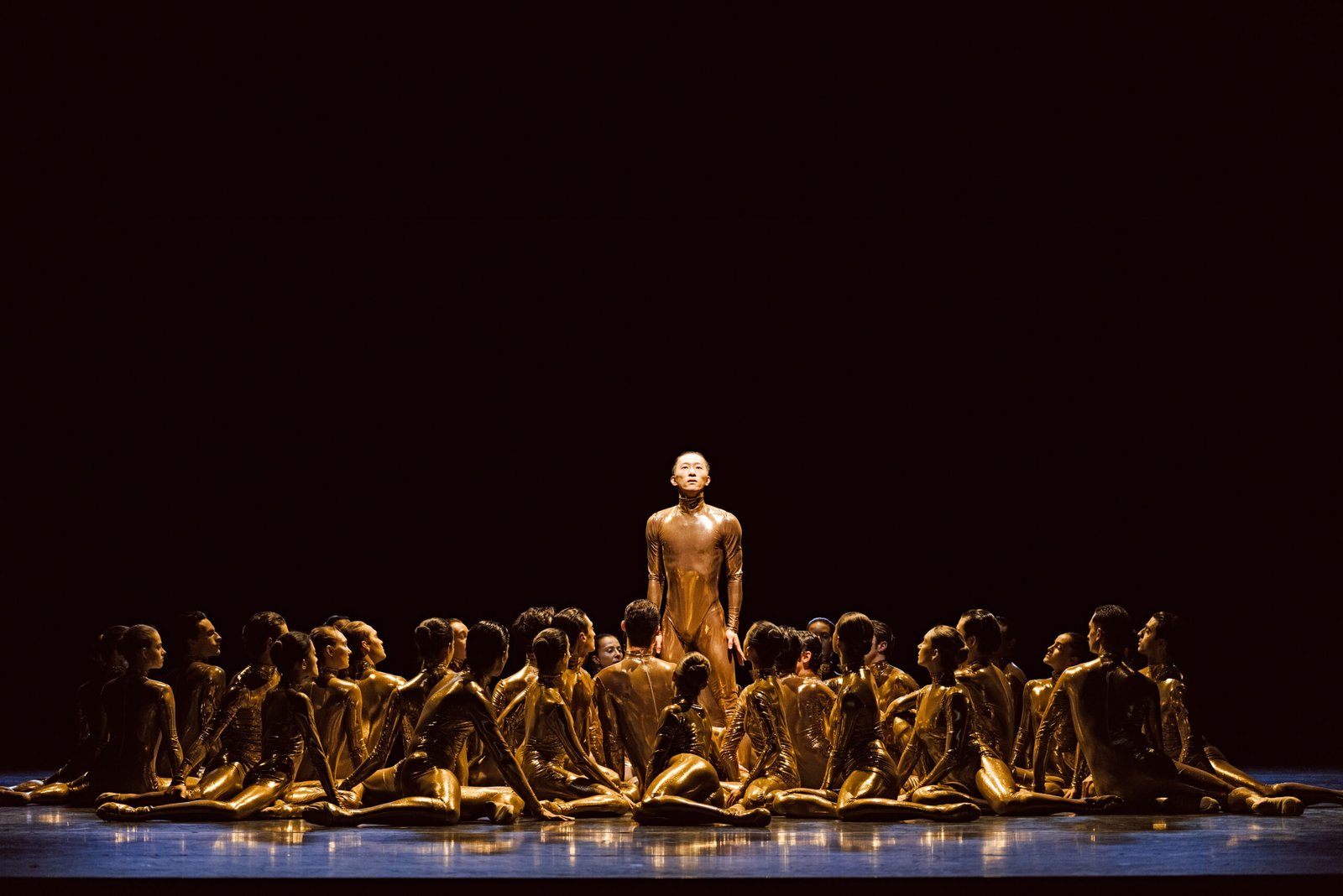
One (actually two) of my favorite moments was when the ensemble dancers all piled atop each other to form a hill of sorts, that rose, fell, undulated, and “birthed” Pandora from its top. It repeats itself later, toward the ballet’s end, but now the ensemble are clad in a gold version of the shiny neck-to-toe unitard, this time lifting up Hope in the same way. Wow, those gorgeous toned dancers’ bodies in a golden, almost molten heap, was a visual stunner.
Like in 2024, I still have mixed feelings about the AI-informed upstage panel projections. Sometimes they worked, sometimes they merely distracted from watching the dancers. Prometheus’s theft of fire was brilliantly done. Pandora’s opening of the jar, unleashing all sorts of chaos, however, became the thing I liked least about the ballet. The stage is dark and Pandora stands in silhouette. We are held captive through a punishing stretch of time where all focus is on the three enormous panels spewing AI end-of-the-world stuff, all while Pandora stands stock-still. It goes on and on and on and I was squirming in my chair. It didn’t feel like art, it felt like a lecture. It certainly didn’t resemble ballet. Less is more, as they say, and this would have been a perfect case in point. If it had lasted half the time, or if Pandora had been given some movement, even as simple as slumping to her knees, my opinion might be entirely changed.
But now for the opening question: did I love it or hate it? While I’m not going to gush that “wow, now I love it!”, the truth is, I can no longer “hate” or even dislike this ballet. It serves a vital purpose. It shakes up “the ballet” as an institution. It’s a fire hose to the senses and blasts people awake. People will talk about this ballet, and in its 2024 debut, it was precisely what Tamara Rojo wanted to do in her first season as artistic director. We audience members can argue over whether we hate it or we love it, but few people will walk away feeling indifferent. This production also holds great power to draw in younger audiences who might never otherwise consider going to the ballet because they consider it too stuffy. And while I might be an old fuddy-duddy, loving classical ballet just the way it is, I can recognize that engaging younger and/or unexpected audiences in 2026 is a very, very important thing to be doing.
Go to this ballet. Whether you hate it or love it, it has a lot to say.
Editor’s note on 8/30/26: The Mere Mortals soundtrack, composed by Sam Shepherd, AKA Floating Points, has arrived! Check it out HERE and learn more about it HERE.
Well put. I saw it and I’m glad I saw it, but I share some of your feelings. Nice review.
Thanks, Tom! Glad you liked the review and glad you saw the performance!