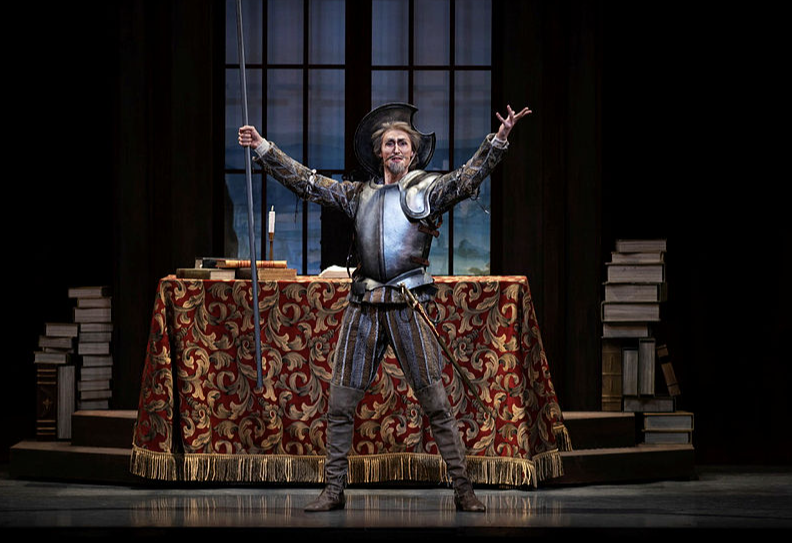
Sizzles isn’t the right word. Or maybe it’s the perfect word. Don Quixote opened at San Francisco’s War Memorial Opera House on March 19th on the waning end of a massive California heat wave — meaning, still too hot.
But there was a silver lining. San Francisco, normally cool-to-chilly most months of the year, had a decided spring-break vibe on Saturday afternoon that made enjoying lunch al fresco and attending Don Quixote all the more fun. It was as if we could all throw our heavy coats and baggage aside and bask in a delightful afternoon — a blissed-out, rollicking escape from reality, reminding me of the importance of the performing arts in times like these.
The production, a 2003 restaging by former artistic director Helgi Tomasson and resident choreographer Yuri Possokhov after the 1869 Petipa classic (and Alexander Gorsky’s 1900 staging), takes its name and a nub of its premise from the Cervantes novel. At its core, it’s a playful Spanish romp: young lovers Kitri and Basilio resist her innkeeper father’s wishes to marry her off to the wealthier, foppish Gamache (a show-stealing Jakub Groot). Into the town square rides the aging Don Quixote (Nathaniel Remez) on a white horse — a real one! — in pursuit of adventure and chivalry, accompanied by his squire Sancho Panza (a reliably hilarious Pascal Molat). The gorgeous candy-colored costumes and appealing Spanish town-square set are courtesy of the late designer Martin Pakledinaz. The ensemble work was fabulous, with polished solos from Kitri’s friends (SunMin Lee, Leili Rackow), and impressive fan work throughout — snapping a Spanish fan open and closed with panache is no small feat; doing so in unison is even more impressive.
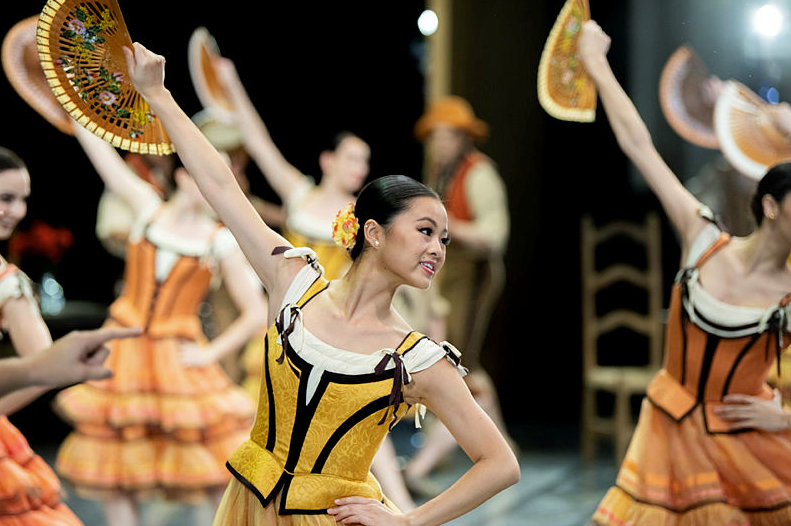
I suspected Nikisha Fogo, a seasoned principal, would be a delightful Kitri and she did not disappoint. Always fun to watch are the iconic “Kitri” leaps, where neck and arms are arched back as the dancer’s legs scissor in a 180-degree splits, making it seem like she can reach back and touch her foot. Fogo delivered this, and everything, with verve and the playful spirit that defines the role. Equally satisfying was the way she stretched luxuriantly into each pose, wielding her fan as a sensuous extension of her arm.
As Basilio, first-soloist Joshua Jack Price was impressive and great fun to watch. From bravura leaps and turns to strong partnering skills and a winning stage presence, he’s growing stronger as a performer with each season. This was the best I’ve seen him. He and Fogo two danced beautifully together, their characters sympathetic, their tandem moves perfectly synched.
Jacey Gailliard is another dancer to watch, debuting in the plum role of Mercedes. I’ve had my eye on her since her first season, when she held her own alongside seasoned soloists with real authority. Here, she did quite well. Adrian Zeisel, the bullfighter Espada, also had a good performance. I’ve seen him in soloist roles but haven’t had that ‘wow’ moment till now. His movements and demeanor were proud, regal and assured, very “bullfighter.”
Act II opens on a Gitano encampment in a countryside dotted with windmills, bringing lively dancing and strong solos from Alexis Francisco Valdez and Kamryn Baldwin. There’s some madcap pursuit of Kitri and Basilio by her father and Gamache, Sancho and a befuddled Don Quixote. Lured by a puppet-show distraction, he descends into confusion and starts charging at the others with his jousting pole, then at a moving windmill, before collapsing.
The dream scene, sort of a “ballet within a ballet,” is full of charm, a moonlit dreamscape — dark blue backdrop, full moon, stars — augmented by some of Ludwig Minkus’ most romantic music. It’s the ballet at its most ethereal, a striking mood shift. A somber, tutu-clad Kitri appears to Don Quixote dancing as Dulcinea, his idealized love. Other noteworthy solos include a charming Cupid (Hui-Wen Peng) and an impressive Jihyun Choi as the Queen of the Driads — another dancer to watch. Her technical precision, assured grace and leggy extensions are reminiscent of former principal Yuan Yuan Tan; I have a hunch we’ll be seeing her in bigger roles soon.
For many ballet lovers, the Act III wedding Grand Pas de Deux is how they best know the ballet. It’s a prominent fixture in galas and international competitions, and a revealing measure of a dancer’s caliber. And oh, how well it was done on Saturday afternoon. A particularly thrilling moment: amid a challenging passage on the diagonal, Kitri takes a step into an unsupported inside turn, leg out in à la seconde, and turns like a music-box ballerina. For my non-ballet readers, suffice to say it’s crucial here for the dancer to have iron core strength and a sense of her own balance, turning 1 ½ rotations until her partner catches her by the waist and dips her into a penché arabesque en pointe. Super hard, and she nailed it, not once but twice. Price’s contribution was equally essential: unobtrusive support, never in the way, never missing a cue. The pas de deux also included gravity-defying one-handed overhead lifts into perilously-looking fish dives, bravura solos for each of them, and an explosive coda where each seemed to be gleefully one-upping the other. The energy ratcheted ever upward — high leaps and turns for him, two dozen fouetté turns for her, with double rotations regularly tossed— building to a triumphant finish. I had prickles. Even tears.
Wow. Just so much fun.
In case I haven’t drummed it in fully, San Francisco Ballet’s Don Quixote is a production to get out and see, particularly if you’re a fan of Tomasson’s Nutcracker. If that’s the only ballet you’ve ever seen and you’re looking for the next toe-dip into the classical ballet repertoire, this would be it. The sheer fun of it is its own reward.